Key facts: Structural Drying on the Lakeshore
- Lake Stevens drains through one outlet channel, so high water can last for days after rain ends.
- Published Everett normals show about 5.8 inches of precipitation in November.
- Keeping indoor humidity below 60 percent is the EPA's general household target.
- Summer-home lots on the shore were commonly rebuilt as larger year-round homes.
The difference
The extra moisture source a lakefront job has to plan for
Inland, a drying job has a clear end point: stop the leak, remove the water and dry what got wet. Next to the lake, there can be a second source that nobody can turn off. When the lake is high, the ground around a shoreline house can stay saturated, and moisture keeps rising into any crawlspace above that ground. It does not mean the job cannot be done. It means the plan has to separate what can be finished now from what has to wait.
This is more than a theoretical concern. Everett Herald reporting described a shoreline household with nearly a foot of standing water on the lawn over two winters, and a 2020 outlet study found that in the wet season the outlet channel's size sets how fast the lake can fall, not the weir. [1] So a lake that rises in a December storm may not fall for quite some time. Ask how the contractor intends to handle that, rather than assuming the same schedule as a job on the hill.
The general mechanics are explained on our main structural drying page. What follows is about how they change on a lot beside the water.
Staging the job
A sensible order of work when the lake is high
- 1
Remove water and wet finishes now
Standing water, wet pad and soaked trim should not wait for the lake to fall.
- 2
Dry the rooms first
Living spaces above the floor can usually be dried with a closed setup and dehumidifiers.
- 3
Take out wet insulation below
Wet batts hold water against the floor framing whatever the lake is doing.
- 4
Check the crawlspace supply
If water keeps returning from the ground, record it and hold off on the final dry-out.
- 5
Return when the ground drops
A second visit to finish the crawlspace is common, so ask about it at the start.
- 6
Replace insulation last
New batts go in once the wood reads dry, not before.
Features
Shoreline features that change the drying plan
| Feature | Effect on drying | What to ask |
|---|---|---|
| Crawlspace close to the water table | Moisture keeps coming from the soil | Can the space be closed off from the ground for now? |
| Additions from different eras | Separate cavities and uneven floors | Is each section being measured? |
| Large lake-facing windows | Cold surfaces and condensation | Where will humidity be read? |
| Fill behind a bulkhead | Soil may drain unevenly | Where does water stand after storms? |
| Older interior finishes | Materials may need testing before cutting | What is the plan before opening walls? |
| Lower-level rooms on sloped lots | Below-grade walls release moisture slowly | How long should this wall take? |
Air
Windows closed or open beside the lake?
People who live on the water like to open up the house, and in July that is a fine idea. In the wet months it usually is not. Published 1991-2020 normals from an Everett station about six miles west show November near 5.8 inches and December and January near 5, and modelled Open-Meteo figures for Lake Stevens read much higher, though those may overstate things. On a raw, rainy day the air outside can already be close to saturated. Letting it in means your dehumidifier spends its time on outdoor air instead of the moisture in your walls.
An easy way to test it is to compare the humidity and temperature inside and out. A contractor will often do this with a thermo-hygrometer, and it is reasonable to ask for the numbers. If the indoor air is drier, keep the windows shut. In a dry spell, the answer might change. The EPA's household target of below 60 percent humidity, ideally 30 to 50, is the long-term aim once the job is finished. [5] During drying, equipment commonly pulls the air lower.
Mixed construction
Older cabins inside newer houses
HistoryLink records that the shoreline was divided into small summer lots early on, and that small homes and cabins were gradually replaced by larger year-round houses. Where a cabin was enlarged instead of being replaced, one house can contain several different kinds of wall and floor. Old solid lumber sits beside newer engineered framing, and an old floor may lie beneath a newer one.
That matters for drying, because layered floors are slow and trapped water has nowhere to go. A moisture reading taken at one spot may say nothing about the room next door. Ask for readings in each section, and be ready for a finish to come up if it is holding water underneath. In older sections, ask about testing for asbestos or lead before anyone starts cutting.
- Layers of old flooring slow drying
- Read each section separately
- Ask about testing before cutting old finishes
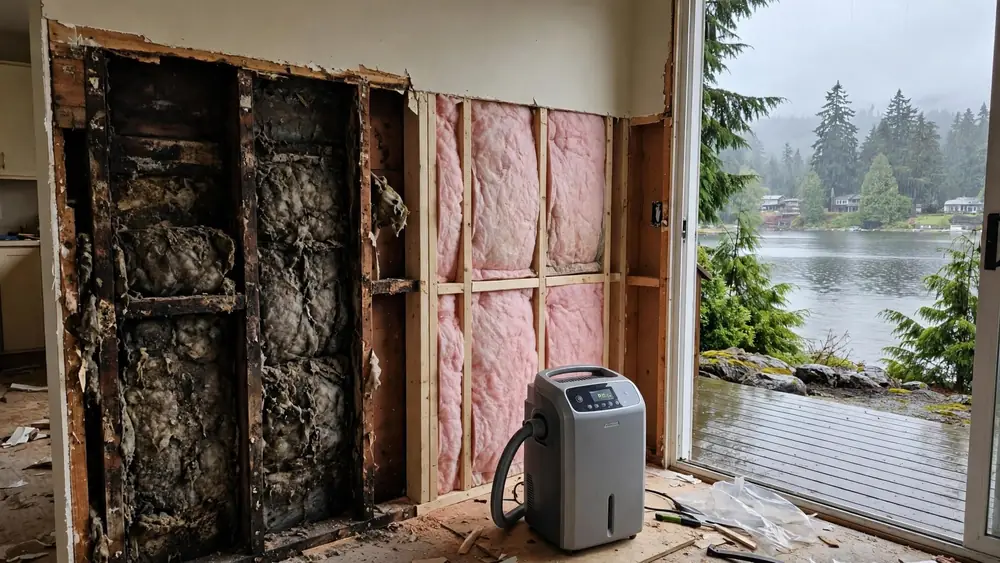
Finished
Knowing when a lakefront job is really finished
A dry reading in the living room is not the end of the job if the floor framing below is still wet. Ask to see readings on the joists and subfloor from below, as well as from the rooms above. Readings should be compared with unaffected material of the same kind in your own house. Keep the records, as they will help if you have to explain to an insurer why a second visit was needed. Check too that any contractor you use is registered through Washington L&I's Verify tool. [7]
Then think about what comes next. A shoreline home may get wet again in a future winter, so this is a good time to ask if replacement materials on the lowest levels could be more tolerant of water, and whether anything stored low should move up.
FAQ
Drying questions from lakefront owners
Why is my crawlspace still damp after drying equipment ran?
If the lake or the ground water is high, moisture can keep rising through the soil. The wood may dry and then take up moisture again. Ask for readings over time, and consider finishing that stage once the water has dropped.
Should drying wait until the lake goes down?
Not entirely. Remove water, wet finishes and soaked insulation right away, and dry the rooms. Final work under the floor can wait for the ground to drop, if moisture keeps coming back. Ask for a plan that covers both stages.
Does living by the lake make indoor humidity higher?
It can, particularly in damp weather with windows open, although your own habits and ventilation matter as well. A small hygrometer tells you what is actually happening, so aim for below 60 percent, as the EPA suggests.
Can lake water be dried in place like a pipe leak?
Generally not for porous materials. Washington's health guidance treats lake and river floodwater as black water, so soaked carpet, insulation and drywall usually come out first. Hard surfaces are cleaned, and then the structure is dried.
How long does drying take in a lakefront house?
Nobody can tell until materials are measured. Layered floors, cold rooms and a wet crawlspace all add time, and a high lake can add a second stage. Ask what readings the contractor is aiming for, and how often they will check.
Sources and citations
- [1]Some Lake Stevens homeowners now must buy flood insurance (Everett Herald, 2021)
- [2]Lake Stevens thumbnail history (HistoryLink)
- [3]Everett climate normals 1991-2020, NOAA station data (Climate-Zone)
- [4]Open-Meteo historical weather model (modelled data)
- [5]A brief guide to mold, moisture and your home (US EPA)
- [6]Flood cleanup to protect indoor air and your health (US EPA)
- [7]Verify a contractor, tradesperson or business (Washington L&I)
- [8]Permit center (City of Lake Stevens)