Key facts: Structural Drying in Hartford
- Hartford lies about a mile northeast of downtown Lake Stevens.
- The outlet channel overtopped Hartford Drive during the record rain of November 2021.
- Washington guidance treats lake and river floodwater as black water.
- Wood framing can usually be cleaned and dried, while soaked porous materials generally come out.
Water source
Start by asking what the water was
Hartford began as a rail depot, and today the wider area holds both homes and the city's Hartford Industrial Area. It also sits close to the lake's outlet, which runs along Hartford Road and Hartford Drive to Catherine Creek. This means a wet floor here might have come from any of several places, and the source decides what comes first.
Water from a broken supply line can be dried straight away if it is dealt with soon. Water that came across the road or up from the creek is a different matter. Washington's flood guidance says lake and river flood water counts as black water, and the EPA warns that floodwater may carry bacteria or chemicals. [5] [6] Around roads and industrial lots, there can also be oil or fuel. So porous materials generally come out, surfaces are cleaned and only then does drying equipment go in. Running air movers over contaminated material may just spread it around.
Our main structural drying page explains drying methods. On this page, we look at what changes in this part of town.
Sources
How the source changes the first step
| Source | First step | Then |
|---|---|---|
| Supply line or appliance | Stop the water and extract | Dry, keeping most framing in place |
| Roof or siding leak | Temporary protection | Open and dry affected walls |
| Channel or creek overflow | Wait until safe, then remove mud | Clean, then dry |
| Septic or sewer backup | Stop using water | Sanitize, then dry |
| Sheen or fuel smell | Stay out and report it | Specialist assessment first |
| Rising ground water | Pump if useful | Dry after the ground falls |
Older buildings
Drying old wood and old walls
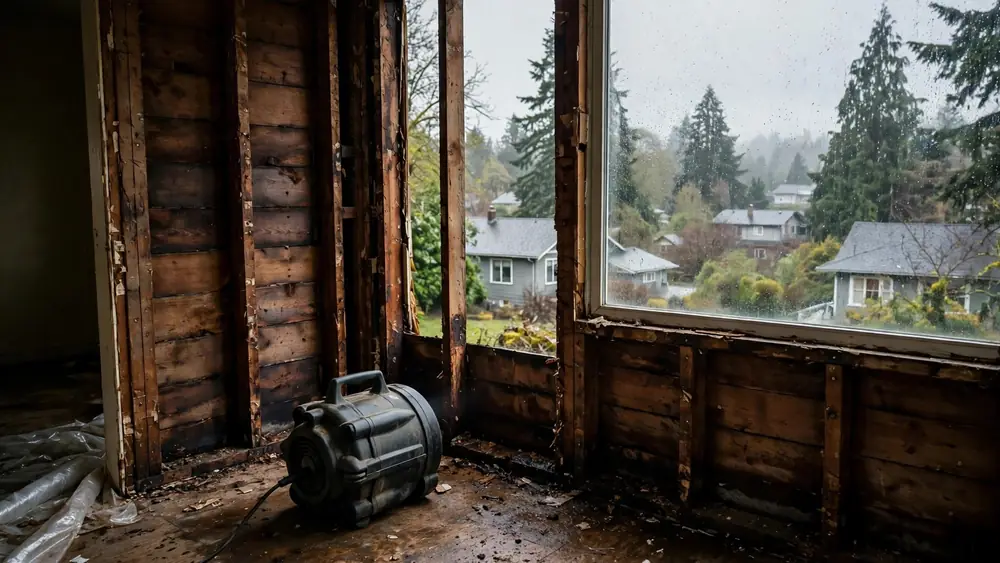
Older solid lumber generally tolerates being wet and dried better than some modern engineered products, as long as it was sound to begin with. The catch is that older walls can hide earlier problems. When walls open up, you might find old water stains, repairs and soft sill plates. Ask for a photo and note whether the damage looks old or new. It is useful information for you and for any insurer.
Old finishes raise a different issue. Plaster, old floor coverings and painted trim may contain materials that should be tested before anyone cuts into them. Ask about asbestos and lead before the demolition stage, not after. Plaster walls also dry slowly, and they do not respond to the same methods as modern drywall, so a contractor might suggest a different approach to them.
- Sound old lumber usually dries well
- Ask about testing before cutting
- Plaster dries slowly
Below the floor
Low lots and damp crawlspaces
Low ground near a channel and a creek will often stay wet for much of the winter. If a crawlspace here has bare soil, a torn plastic cover or old post-and-pier supports, it may never be fully dry in winter, whatever you do inside. This does not make drying pointless, since the structure still needs to come down from its wet state. It does change what you should expect.
Everett's published normals show about 5.8 inches in November and around 5 inches in both December and January, with modelled Lake Stevens figures reading higher, but possibly overstated. Water may arrive from rain and from the lake's outflow, and the channel can stay high after a storm. Plan to remove wet insulation and any contaminated ground cover as soon as it is safe, and to complete the final drying and new ground cover once the ground water has dropped.
Sequence
How a mixed-source job usually proceeds here
- 1
Wait for safety
Don't enter moving water, and have power checked if water reached the panel.
- 2
Report any overflow
Tell the city about water crossing the road or a blocked culvert.
- 3
Clear mud and debris
State guidance says to shovel out mud once water is gone, so that floors and walls can dry.
- 4
Remove porous materials
Soaked carpet, insulation and drywall generally come out.
- 5
Clean hard surfaces
Wash and rinse surfaces, including framing, before drying.
- 6
Dry and measure
Run equipment and take readings until materials reach a dry standard.
- 7
Check the wastewater system
If you are on septic, have it checked once water recedes before normal use.
On site
Access, outbuildings and power around Hartford
Larger lots and older buildings can present practical issues. Older electrical panels may not take the load of drying equipment, so tell the contractor what you have. Long distances between the road and the building may limit truck-mounted gear, and soft wet ground can trap a heavy vehicle. Mark any septic tank and drainfield before a truck arrives, because Washington's guidance warns against driving equipment over a wet drainfield.
If the damage involves a shop or a detached garage, ask if it is part of the same job. These buildings may have bare framing that dries quite easily, but with stored fuel or chemicals that have to be dealt with first. Before any work starts, you can check a contractor's registration through the Washington L&I Verify tool. [8] If you are not sure whether your building is inside the city limits, check first, as that determines who issues permits for the repairs.
FAQ
Drying questions from the Hartford area
Can I start drying right after channel water leaves my house?
Clean up first. Treat it as contaminated, shovel out mud and remove soaked porous materials, then wash hard surfaces. Fans and dehumidifiers come after that. Starting with fans over dirty, wet materials can spread contamination and slow the job down.
Does old wood need to be replaced after it gets wet?
Usually not, if it was sound beforehand and it is dried soon after. Soft, crumbly or rotted wood is another matter. Have someone probe suspect spots, especially sills near the ground, and photograph what they find.
How do I dry a plaster wall?
Slowly and with care. Plaster holds water and releases it gradually, so readings matter more than the calendar. Soaked plaster that is soft to the touch usually has to come out. Ask about testing older materials before anyone cuts into them.
Should I run a generator for drying equipment if the power is out?
Only outdoors, away from doors and windows, because of carbon monoxide. Have the wiring checked if it got wet. Let the contractor know the power status when you call, as this affects what equipment they would bring.
Why is my crawlspace not reaching dry readings in January?
The ground may be supplying moisture faster than it can be removed, particularly on low lots. Remove wet insulation and take readings on the wood. It may make more sense to finish that stage when ground water falls.
Sources and citations
- [1]Lake Stevens thumbnail history (HistoryLink)
- [2]Lake Stevens, Washington (Wikipedia)
- [3]Some Lake Stevens homeowners now must buy flood insurance (Everett Herald, 2021)
- [4]Rainstorms push Lake Stevens to a near-record level (Everett Herald, 2015)
- [5]Flood cleanup (Washington State Department of Health)
- [6]Flood cleanup to protect indoor air quality (US EPA)
- [7]A brief guide to mold, moisture and your home (US EPA)
- [8]Verify a contractor, tradesperson or business (Washington L&I)
- [9]Permit center (City of Lake Stevens)