Key facts: Crawlspace Water on the Lakeshore
- The lake covers 1,040 acres with 7.1 miles of shoreline.
- A 2020 outlet study found the channel, not the weir, controls the wet-season lake level.
- Lake and river floodwater is considered black water in Washington guidance.
- A typical home policy does not cover flooding, the state regulator says.
How it happens
Why shoreline crawlspaces fill from below
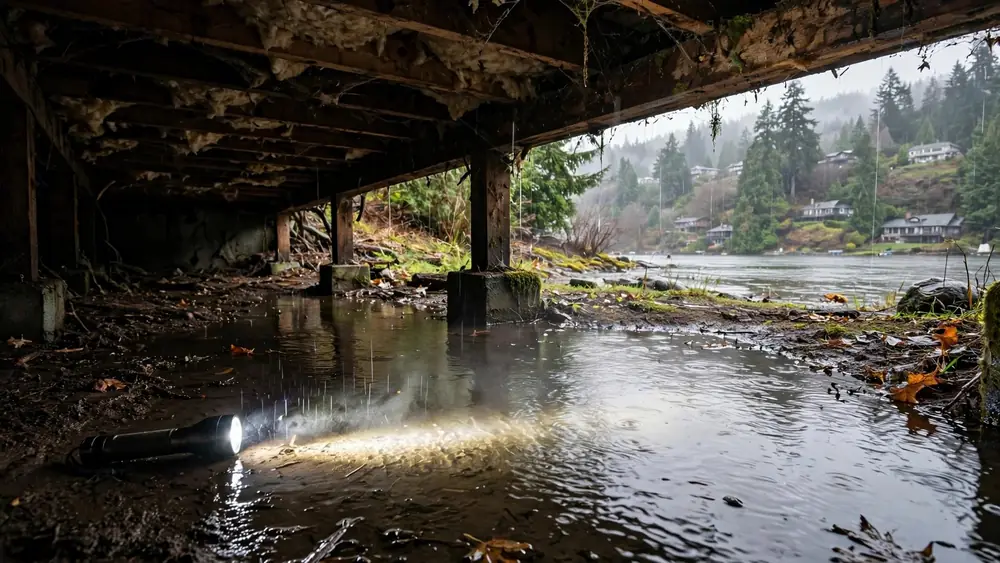
A crawlspace on an inland hill gets water mostly from the side or from pipes. A crawlspace by the lake has another source: the water table. When the lake is high and the soil has been soaking for weeks, the ground around the house has nowhere to drain. Water finds its way up through the dirt floor, and it often appears in the lowest corner first. Everett Herald reporting described nearly a foot of standing water on one lakeside lawn over two winters. [2] A crawlspace on a lot like that could be wet long before water is anywhere near the floor.
The shoreline itself has been changed a great deal. HistoryLink notes that few nearshore lots kept their native vegetation, and that bulkheads and fill became common. Fill can drain differently from native soil, and a bulkhead holds back the land but does not stop water moving underneath or around it. So two neighboring houses can behave quite differently in the same storm.
See our main crawlspace water damage page for the general process. What follows deals with the shoreline.
Reading it
Reading the water beneath a lakefront house
| What you see | What it may mean | What to do |
|---|---|---|
| Water rises and falls with the lake | Ground water tied to lake level | Compare your photos with the lake over days |
| Water in one low corner | Natural low point or a local drain issue | Check downspouts and yard drains on that side |
| Water when the lake is normal | Plumbing or roof runoff | Read the water meter with everything off |
| Silt or debris left behind | Surface water came in | Treat it as contaminated |
| Sewage smell | Drain line or septic issue | Stay out, and stop using water |
| Wet insulation with a dry floor below | Leak from above | Look for plumbing overhead |
Pumping
Is pumping worth it when the lake is high?
Pumping feels like the obvious thing to do, but the answer depends on where the water comes from. If it came in from a storm or a pipe, and the ground around is not holding more, pumping it out makes sense and should be done soon. If the water table is high, you can pump all day and still watch it come back, because you are effectively trying to lower the water level of the ground around your house.
There is also a safety point. Washington's guidance on basements warns that draining a below-grade space too soon can push walls in or make floors heave, because the water inside helps brace the walls against the saturated soil outside. [5] It says to wait until most of the floodwater outside has receded and to pump at about the rate the outside water falls. A shallow crawlspace has less at stake than a full basement, but on lots with taller foundation walls it is worth raising this question.
If you have a sump, keep it running as long as it can do so safely. Ask where it discharges. Water sent out next to the foundation will soon return.
Timing
What can be done now and what should wait
- 1
Now: make it safe
Keep out if water is near wiring or if you smell sewage. Check the panel situation.
- 2
Now: find out what the water is
Treat anything from outside as contaminated, in line with state guidance.
- 3
Now: photograph it
Take dated photos from the hatch each day to build a record.
- 4
Soon: remove soaked insulation
Wet batts add weight and hold moisture, so they generally come out as soon as it is safe to work.
- 5
Later: dry the framing
Final drying works best once the ground has stopped supplying water.
- 6
Later: new ground cover and insulation
These go in on clean, dry surfaces at the very end.
Materials
What the water table does to materials
Long periods of damp air under a house take a toll even without standing water. Joists and sills can pick up moisture, metal connectors may start to rust, and old insulation can absorb humidity and sag. In an older cabin that has been extended, the lowest parts of the structure may be quite close to the ground.
Ask for the wood to be checked with a moisture meter and probed for soft spots, especially near any outside walls. If there is damage, take a photograph and have it looked at by somebody who repairs structure. It may be older than this winter's flooding, which matters both for the repair and for your insurance conversation.
- Check sills and joist ends
- Look for rusted hangers and connectors
- Photograph anything soft
Insurance
Insurance when the crawlspace is the only thing wet
Crawlspace water raises hard questions, because the living space may be untouched. Washington's Insurance Commissioner says a typical home policy does not cover flooding, and insurers often treat ground water separately as well. [6] Flood policies have their own rules about what they cover below the first floor, and you should read yours closely instead of assuming either way. If a pipe under the floor caused the problem, that is a very different conversation.
Your dated photos and any record of the lake level help you explain what happened. National Flood Insurance Program coverage usually begins 30 days after purchase, unless a mortgage requires it, so it cannot be arranged at the last minute. Summer is a good time to talk to an agent. Ask specifically what is covered in a crawlspace.
Prevention
Keeping a lakefront crawlspace in better shape
You cannot change the lake, but you can limit how much extra water you add to the ground. Send downspouts away from the house, using solid pipe if you need to, and do not let them drain toward the low side of the lot. Keep vents clear, and make sure that no landscaping has buried them. Check the plastic ground cover in late summer, and repair it while the soil is dry. Move anything stored under the floor up onto shelves or out altogether. If you have a sump pump, test it in October, and look at where its outlet goes.
FAQ
Lakefront crawlspace questions
Why does water appear under my house when it has not rained for days?
The lake can stay high after rain ends, since it can only drain through one channel, and the ground near it stays saturated. If there has been no rain and the lake is normal, check for a plumbing leak.
Will a sump pump keep lake water out of my crawlspace?
It can manage water that collects, but it cannot lower a high water table very far. It helps most when it discharges well away from the house. Ask someone who has looked at your property how much it might help.
Is water under my house dangerous if it came from the lake?
Treat it as contaminated. Washington guidance considers lake and river floodwater as black water. [4] Stay out, keep children and pets away and have soaked insulation and ground cover removed once it is safe.
Does this mean my foundation is failing?
Not necessarily. Water in a crawlspace is a separate issue from the strength of the foundation. New cracks, sloping floors or doors that suddenly stick are reasons to get a structural opinion, particularly on filled lots.
Should I insulate again before the winter is over?
Usually not. New batts over damp wood will trap moisture. Remove what is wet, keep the area as dry as possible and reinstall once readings on the wood show that it has dried. Ask your contractor about the timing.
Sources and citations
- [1]Lake Stevens, Washington (Wikipedia)
- [2]Some Lake Stevens homeowners now must buy flood insurance (Everett Herald, 2021)
- [3]Lake Stevens thumbnail history (HistoryLink)
- [4]Flood cleanup (Washington State Department of Health)
- [5]Floods: cleaning a basement (Washington State Department of Health)
- [6]Flood insurance (Washington Office of the Insurance Commissioner)
- [7]Flood cleanup to protect indoor air quality (US EPA)
- [8]Verify a contractor, tradesperson or business (Washington L&I)