Key facts: Crawlspace Water in Hartford
- The lake's outlet runs along Hartford Road and spills into Catherine Creek.
- Catherine Creek eventually drains to the Pilchuck River.
- Washington's Department of Health says to stop using a septic system during a flood.
- Do not drive equipment near or over a wet drainfield, state guidance warns.
Sources
Four kinds of water under a house here
Crawlspaces near the lake's outlet can take on water for several different reasons, and each one means something different for you. The first is overflow. The Herald reported that the channel spilled over Hartford Drive in the record rain of November 2021, and low lots nearby can take that water on. The second is ground water from soil that has been wet for weeks, close to a channel and creek. The third is your wastewater system, if a saturated drainfield or blocked side sewer sends water back toward the house. The fourth is ordinary plumbing, which can fail anywhere.
Sort these out first, as they differ in what you can touch, who you call and how the job is done. Smell and debris tell you a lot. Clear water and no odor suggests a leak or ground water. Silt and leaves suggest water came from the surface. A sewage smell means stopping all water use and staying out. For the general process, see our main crawlspace water damage page.
Telling them apart
Telling the sources apart around Hartford
| Source | Clues | First call |
|---|---|---|
| Channel or creek overflow | Silt, debris, road water nearby | City for overflow, then your flood insurer |
| Ground water | Clear water, rises slowly and falls slowly | Restoration or drainage contractor |
| Septic or sewer | Odor, slow drains, grey water | Plumber or septic professional, and health department if flooded |
| Plumbing supply leak | Clear water in dry weather, meter moves | Plumber |
| Fuel or chemicals | Sheen or strong smell | 911 or authorities if there is danger |
Septic
Septic systems beneath saturated ground
If your property uses septic, a wet crawlspace and a wet drainfield often show up at the same time. Washington's Department of Health says to stop using the system during a flood, including toilets, showers, sinks, washing machine and dishwasher. After the water recedes, it says tanks need checking, with pumping if required, that your local health department should be told if the system or drainfield was affected, and that equipment should stay off the wet drainfield. [5]
That last one matters when a truck arrives to pump out your crawlspace. Mark where the tank and field are, and point them out before anyone drives on the lot. If you do not know where they are, the local health department may have records. Do not guess, as heavy equipment on wet soil can cause lasting damage to a drainfield.
Older foundations
Older foundations and post-and-pier supports
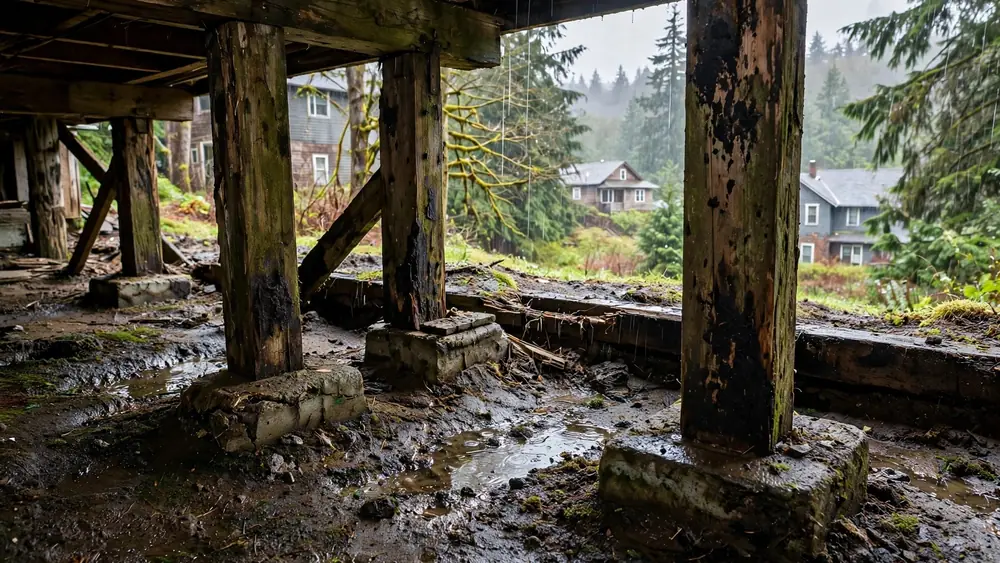
Older buildings in this part of town may sit on post-and-pier supports, old concrete or additions built at different times. Wood posts near wet soil are prone to decay at the bottom, and low clearance makes access hard. A flood can also shift things slightly: a pier that has settled, or a post that has moved, can show up as a sloping floor.
Ask whoever goes under the house to look at these supports, to probe the wood and to take photographs. If you see movement, call in someone who does structural repairs. That work may require a building permit, so check whether the property falls inside the city limits, and ask the permit center or Snohomish County.
- Check posts at ground level
- Note any new floor slopes
- Photograph what is found
Steps
Working through a flooded crawlspace near the channel
- 1
Wait for it to be safe
Do not go in while the water is moving, rising or near live wiring.
- 2
Report what is happening
Tell the city about any blocked culverts or water across the road.
- 3
Stop using septic if flooded
Follow state guidance, and hold off on normal use until it is checked.
- 4
Pump once appropriate
Remove water when the source has stopped supplying it.
- 5
Clear silt and old materials
Silt, wet insulation and contaminated plastic all come out.
- 6
Clean and dry the wood
Framing is cleaned and then dried, with readings to confirm.
- 7
Finish last
New ground cover and insulation go in at the end.
Insurance
Insurance questions for this location
The insurance question comes down to the source again. The state's Insurance Commissioner says a typical home policy does not cover flooding, so channel or creek water usually means a flood policy, if you have one. [8] Sewer or septic backup may need its own endorsement, and pipe leaks are often treated differently. National Flood Insurance Program policies usually begin building coverage 30 days after purchase, unless a mortgage requires it. If you live near the channel, it makes sense to look into this in summer.
Keep dated photographs of the water level, silt lines and any damage to the wood, and note what the channel was doing at the time. When you talk with an adjuster, describe what you saw plainly and explain anything you are unsure of. Check any contractor on the Washington L&I Verify tool before you sign, especially after large storms, when unfamiliar crews may come through. [9]
After the water
Mold and silt left behind
Silt left under a house holds moisture and gives mold something to live on, so it should come out even if the water has gone. Washington's Department of Health advises professional help for mold that is hidden, larger than 3 by 3 feet or contaminated by sewage. [7] A crawlspace that has been flooded may well meet one or more of those tests. Keep the hatch closed while you wait, to limit what rises into the house. If rooms above smell musty after a flood, tell the contractor, as it can help them decide where to look first.
Prevention
Getting ready for next winter
Use the dry months. Mark your septic components, find your water main and take a dry-season photograph from the hatch. Clear what you are allowed to clear from your length of ditch, and report blockages in larger culverts. Store nothing of value under the house. Have a look at the vents to make sure they are clear, and repair any ground cover that has torn. Those few small jobs make a real difference when a wet December comes around.
FAQ
Hartford-area crawlspace questions
How do I know if channel water got under my house?
Look for silt, leaves or a tide line on foundation walls or posts. Water from the surface usually leaves evidence behind. Compare this with what you saw on the road and in your yard at the time, and photograph what you find.
Can I use my toilet if my crawlspace is flooded?
If you are on septic and the system is flooded, state guidance says to stop using it. If you are on sewer and the drains are working normally, it may be fine, but stop at any sign of backup or odor.
Should I wait for the creek to drop before pumping?
Often, yes. If the water is still rising or the ground is saturated, pumped water can come back. Below-grade rooms have added risks if drained too early. Remove wet materials as soon as it is safe to do so.
Do old wood posts need to be replaced after a flood?
Not always. Sound wood can usually be cleaned and dried. Soft or decayed post bases should be evaluated, and a shifted pier may need repair. Have someone probe them, and take photographs for your records.
Who do I call about a blocked culvert near my home?
Contact the City of Lake Stevens, or Snohomish County if you are outside the city. Report the location and take a photo if it is safe. Do not try to clear a culvert during high water.
Sources and citations
- [1]Rainstorms push Lake Stevens to a near-record level (Everett Herald, 2015)
- [2]Lake Stevens, Washington (Wikipedia)
- [3]Lake Stevens thumbnail history (HistoryLink)
- [4]Some Lake Stevens homeowners now must buy flood insurance (Everett Herald, 2021)
- [5]Floods and septic systems (Washington State Department of Health)
- [6]Flood cleanup (Washington State Department of Health)
- [7]Mold (Washington State Department of Health)
- [8]Flood insurance (Washington Office of the Insurance Commissioner)
- [9]Verify a contractor, tradesperson or business (Washington L&I)