Key facts: Crawlspace Water near Frontier Village
- Roofs and pavement shed water quickly, so ground-level spaces depend on working drains.
- The SR 9 and SR 204 intersection became the county's busiest by about the turn of the century.
- Association documents usually determine who handles a shared crawlspace.
- Washington health guidance advises professional help for hidden mold or growth larger than 3 by 3 feet.
Shared crawlspaces
When the space under your floor is not just yours
Some attached homes share a single crawlspace, or have connected bays with one or two access points. This matters for two reasons. First, water and damp air move freely between units, so the problem may start under someone else's home. Second, the space is often counted as common property, which can mean that you cannot simply hire someone to go in and start working.
If you notice a musty smell or a cold floor, tell the manager or association in writing, and ask where the access is. They may have the key or the hatch may be in somebody else's closet. If you rent, this belongs with your landlord. Our main crawlspace water damage page has the general picture of what the job involves; the difference here is mostly about who decides and who has to be involved.
Roles
Who might be involved under an attached home
| Situation | Who to tell | Who usually arranges work |
|---|---|---|
| Shared crawlspace, ground water | Association or manager | Association |
| Shared drain line leak | Association or manager | Association, with a plumber |
| Your own supply line under your unit | Your insurer and the manager | Depends on the documents |
| Rental home | Landlord | Owner |
| Detached home on its own lot | You | You |
| Runoff from a neighboring parking lot | Your insurer and that property's owner | Depends on the cause |
Runoff
Runoff from roofs, roads and parking lots
The commercial core around Frontier Village has a lot of hard surface. Rain does not soak into roofs and pavement, so it runs quickly to drains and swales, and then on to whatever comes next. If a catch basin clogs with leaves or a storm line backs up, then the water may pond along the edge of the nearest building. For residents on the low side of a parking lot or a sloped driveway, this can mean water soaking into the ground beside the foundation and turning up under the floor.
Published Everett normals put November at about 5.8 inches, with similar wet weeks in December and January. Take a photograph of any ponding while it is happening, because it is very hard to prove afterward. Report blocked drains to whoever owns that property, and if it is on a public street, tell the city. A pattern of photos with dates, gathered over one winter, can be a strong basis for asking someone to look at their drainage.
Access
Getting in and working in tight spaces
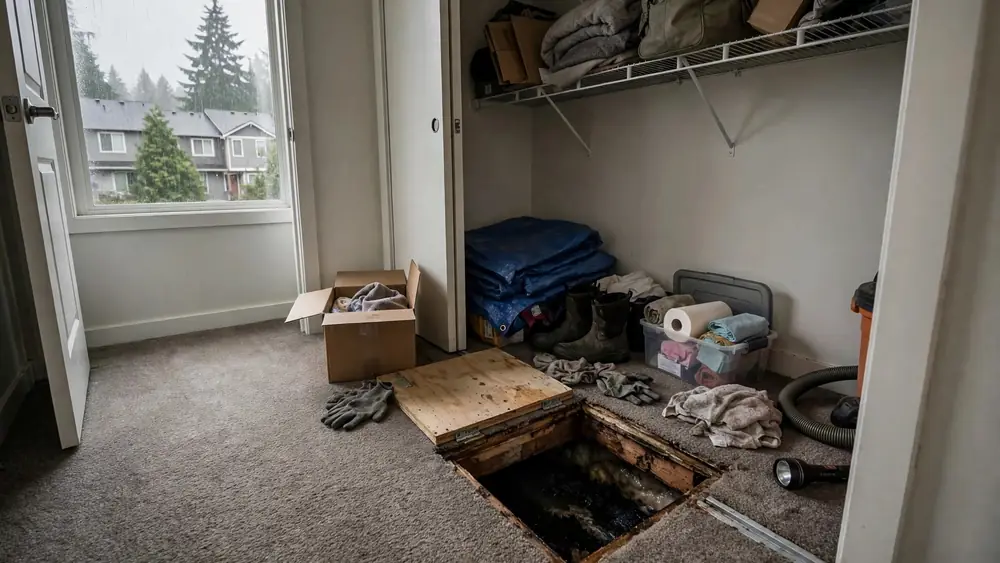
Access can be awkward in these homes. A hatch inside a closet means emptying that closet, and if it is in a neighbor's unit you will need their cooperation. Long, low runs of crawlspace also make it slower and harder to haul out wet insulation, and hoses may have to run through a living area. The contractor should explain how they will protect floors and limit dust.
Tell them the layout when you first talk. Mention parking, assigned spaces and fire lanes as well, since these make a difference to where equipment can go. If you have a tight schedule because others in the building are affected, say so.
- Hatches can be inside closets
- Neighbors may need to give access
- Ask how dust will be controlled
Air quality
Smells, health and neighbors
Air from a crawlspace rises into the homes above it, so a damp shared space can make more than one unit smell musty. Washington's Department of Health advises professional help when mold is hidden or covers more than an area of 3 by 3 feet, and when sewage is involved. [3] Anyone with asthma or a weakened immune system should mention it to the manager early on. If a sewage smell comes up through the floors, stop using the plumbing and tell the manager at once.
It can be difficult when neighbors see things differently. One household notices a smell and another does not, and that does not mean nothing is wrong. Stick with the facts: what you noticed, when you noticed it and what you have asked for. Keep copies of your messages.
Checking
Before you sign anything
Check the contractor on Washington L&I's Verify tool before work starts, and ask the association if it needs certificates. [6] If structural repairs are needed, ask whether the work needs a city permit. A typical home policy does not cover flooding, the state regulator says, so ask how your own policy and any association policy treat water from outside. [5] A plumbing leak can be treated quite differently, so try to pin down the source first.
FAQ
Crawlspace questions near Frontier Village
Who pays to dry a shared crawlspace?
That depends on your association documents and the cause. Common areas often fall to the association, but it can vary. Read your documents, tell your manager in writing and talk to your own insurer about any gaps.
I rent and my floor smells musty. What should I do?
Tell your landlord or manager in writing, with the date and what you noticed. Do not go into the crawlspace yourself. If someone in your home has health concerns, mention them, and ask when the space will be inspected.
Can a parking lot cause water under my house?
It can, if runoff ponds beside your foundation or if a storm drain backs up. Photograph the water while it is there, and report it to the property owner or the city. A drainage professional can help confirm the path.
Why is water under my unit if I have no leak?
Bays are often connected, so the leak may be under a neighbor's home, or water may be coming from the ground. A meter test, a plumber and a look through the access usually help narrow down where it starts.
Do I need my neighbor's permission for crawlspace work?
If the access is in their home, or if the work goes under their unit, yes, you will need cooperation. The manager or association usually arranges this. Ask early, because getting access is often the slowest part of the job.
Sources and citations
- [1]Lake Stevens thumbnail history (HistoryLink)
- [2]Lake Stevens, Washington (Wikipedia)
- [3]Mold (Washington State Department of Health)
- [4]Everett climate normals 1991-2020, NOAA station data (Climate-Zone)
- [5]Flood insurance (Washington Office of the Insurance Commissioner)
- [6]Verify a contractor, tradesperson or business (Washington L&I)
- [7]Permit center (City of Lake Stevens)