Key facts: Crawlspace Water on Cavalero Hill
- Lake Stevens sits on a plateau, with the Snohomish River delta on one side and the Cascade foothills on the other.
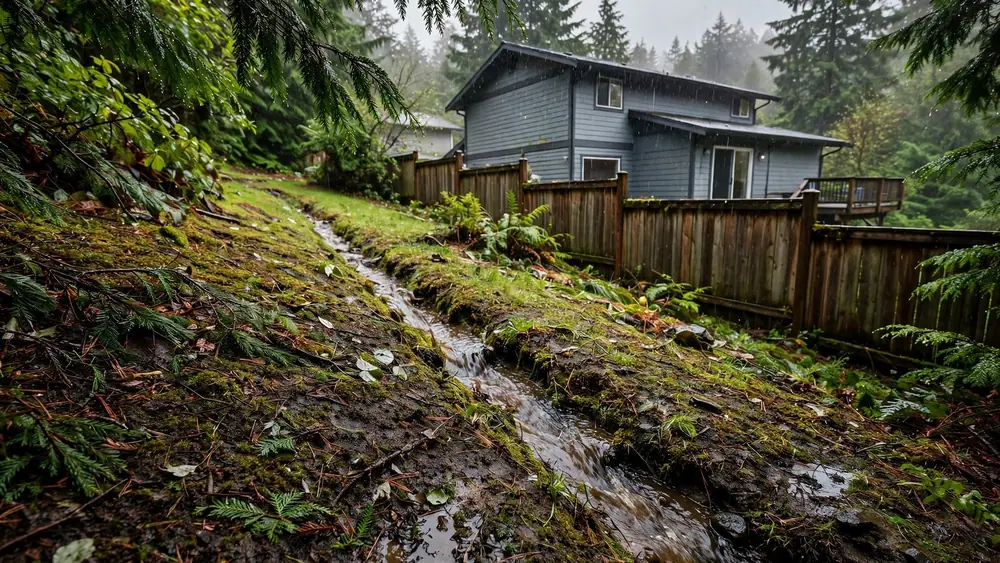
- On a slope, ground water often moves sideways and collects at the uphill wall.
- Wet winters here follow very dry summers in published Everett normals.
- New grading or landscaping can change where water goes.
Reading the space
The wet uphill end
Shine a flashlight across the crawlspace from the hatch, and note where the wet is. If the uphill end is damp and the downhill end is dry, that is a strong clue. Water moves through soil sideways when it meets a denser layer, and a foundation wall cut into a slope is an obvious place for it to collect. It may seep at the footing, come up through the soil just inside the wall or run along the base of the wall to the lowest point.
Compare this with a leak. A plumbing leak leaves a wet spot beneath a bathroom, kitchen or laundry, and it stays wet even in dry weather. Water that arrives only after a few days of rain and clears up within a week or two usually comes from the ground or from surface runoff. Keep notes through one winter to get a clearer pattern. Our main crawlspace water damage page explains the rest of the process.
Clues
Hillside clues and where they point
| Clue | Points to | Next check |
|---|---|---|
| Uphill wall wet, downhill dry | Ground water from the slope | Footing drain and swale |
| Wet below a downspout | Roof water | Extend the downspout |
| Water after a yard project | Changed grading | Slope of new beds or paving |
| Wet below a bathroom in August | Plumbing | Water meter test |
| Wet soil along the whole length | Saturated ground or drain failure | Drain outlet during rain |
| Muddy trails on the soil | Water running through | Where it enters and leaves |
Drains
Footing drains and tightlines
Many houses have some sort of drain system around the footing, and newer homes generally have downspouts connected to buried tightlines. The city's comprehensive plan notes that large parts of Lake Stevens developed in the past several decades, so these systems may now be old enough to have clogged. Roots, silt and crushed pipe can stop them working. When they fail, the water they were carrying can end up right beside the foundation.
Here is a simple way to test it. On a dry day, run a hose into a downspout's underground connection and go to where it should discharge. If the water never comes out, or if it comes out slowly or at the wrong place, something is wrong. If you do not know where it discharges, check any plans you have or ask your association. A drainage contractor can run a camera through the line. It is worth doing that before spending much on other things, as a blocked line is often a simple fix. Keep the roof water separate from the footing drain, if at all possible, because a clogged roof line can flood the footing drain.
Neighbors
What the neighbors' yards can do
On a hill, your water problem might begin on someone else's lot. A new patio, a filled swale or a raised garden bed uphill can send water down to you. If you see this, talk with your neighbor first. Bring photos taken during rain, which tend to go over better than a complaint. It often turns out that nobody meant to change anything.
Your own changes can affect the neighbors below you in the same way. Check the plat or ask the association before you alter drainage, and ask the city if there are any requirements. Drainage disputes can become legal issues, so keep the conversation calm and keep your records.
- Take photos during rain
- Talk before it becomes a dispute
- Check easements before changing the yard
Steps
How a hillside crawlspace job usually goes
- 1
Check from the hatch
Look for wet ends, muddy trails and sagging batts, and take photos.
- 2
Separate plumbing from ground water
A meter test and a dry-weather look rule plumbing in or out.
- 3
Remove water and wet insulation
Pump any standing water and bag soaked batts.
- 4
Dry the framing
Run dehumidifiers and air movers, with moisture readings on the wood.
- 5
Fix the outside source
Extend downspouts, clear swales, or have a drain repaired or added.
- 6
Lay ground cover
Clean plastic goes down on the prepared soil.
- 7
Put insulation back
Do this only after the wood reads dry and the source is under control.
Season
When the wet season starts on the hill
Summers here are dry. Published Everett normals show about an inch of precipitation in each of July and August, then roughly 5.8 inches by November. Modelled figures for the Lake Stevens location read higher, although they may run high. Soil on a slope takes a while to fill up, so the first storms of autumn may do nothing at all. Then, sometime around November, water starts turning up at the footing, usually after a run of wet days. If you only look under the house in summer, you may never see it.
A good habit is to look under the house in September, for a dry baseline, and once again in late November or December after a wet stretch. Keep the two sets of photos together. This gives you, and anyone you hire, a real record of what your particular hillside does.
Mistakes
What not to do
Do not rush into encapsulating a crawlspace that is taking on ground water. Sealing it does not stop water coming in, and water under a sealed liner can be harder to see. Don't dig near the foundation without knowing where the utility lines and drains are. And do not build a retaining wall or a large drain without first checking on permits, especially on steeper ground. If you see signs of ground movement, get professional advice before doing anything else. The Lake Stevens permit center can tell you what requires review, and a typical home policy excludes flood, so ask your agent how ground water would be treated. [6]
FAQ
Crawlspace questions for homes on Cavalero Hill
Can a crawlspace on a hill really flood?
It can collect water, yes. Soil on a slope moves water sideways, and a foundation cut into the hill can intercept it. It usually shows as dampness or shallow water at the uphill end, rather than the rising water you might see by the lake.
How do I know if my footing drain is working?
Look at its outlet during steady rain, if you can find it. Water flowing there is a good sign. A dry outlet with a wet crawlspace suggests a blockage. A drainage contractor can scope the line if you are unsure.
Will gutter cleaning solve my crawlspace water?
It may, if overflowing gutters are dumping water at the foundation. Check the downspout connections too, because a clogged underground line acts just like a blocked gutter. If water still shows up, look at the ground water and drains.
Do I need a sump pump on a hillside lot?
Not always. If you can drain the water away by gravity, that is often simpler. A pump makes sense where the low point of the crawlspace has no other way out. Fix the surface water first, then decide.
My neighbor built a patio and now my crawlspace is wet. What now?
Take dated photos during rain, and raise it with your neighbor calmly. Check with the city about any drainage requirements. If that does not help, a drainage professional can document the water's path, and an attorney can advise you.
Sources and citations
- [1]Lake Stevens, Washington (Wikipedia)
- [2]2024 Comprehensive Plan (City of Lake Stevens)
- [3]Everett climate normals 1991-2020, NOAA station data (Climate-Zone)
- [4]Open-Meteo historical weather model (modelled data)
- [5]Mold (Washington State Department of Health)
- [6]Flood insurance (Washington Office of the Insurance Commissioner)
- [7]Permit center (City of Lake Stevens)
- [8]Verify a contractor, tradesperson or business (Washington L&I)